
Dr. Aliyu Dala is the founder of Raygonal Ltd, an innovative entrepreneur whose interest and passion in fish and fish health began as a child after his collection of fish in the backyard pond suddenly all perished, sadly as a result of an inadequate quality of water and instability in oxygen levels.
The impact of this childhood memory stayed with Aliyu throughout his education, with an academic journey that reflects a transition from core electrical and computer systems into deep-tech environmental engineering. Aliyu’s doctoral research targeted the use of wireless sensor networks and radio frequency (RF) signals for underwater communication and environmental monitoring, which ultimately laid the technical groundwork for a venture into marine technology.
At our Midlothian Science Zone Business Forum on Tuesday 27th October, hosted at Roslin Innovation Centre, Dr. Aliyu Dala outlined his entrepreneurial journey from gaining a PhD in Electrical and Electronics Engineering at The University of Edinburgh to establishing Raygonal Ltd, an agricultural technology company that is revolutionising seafood production with Aquary, an AI-powered, renewable energy-driven system that cultivates fresh, sustainable seafood.
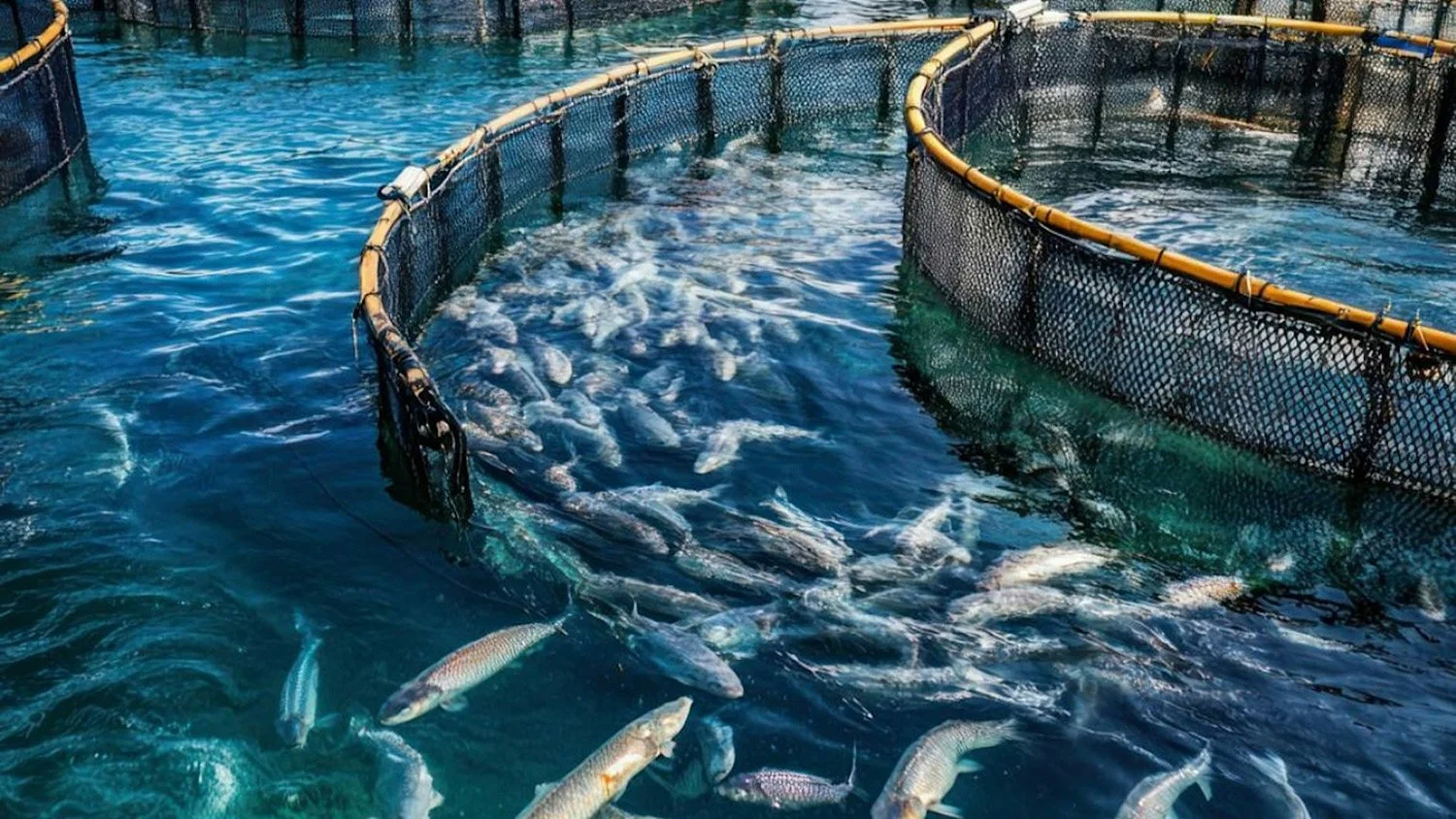
Surging seafood demand
With a rising global demand for seafood, aquaculture production has grown in excess of 600% since 1990. However, global seafood supply chains are inefficient and fragile, exposing the UK market which relies heavily on international trade for the bulk of its seafood, including over £4.1bn in total seafood imports. This has contributed to overfishing and environmentally damaging production practises, neither of which are sustainable, whilst much of this seafood arrives frozen from distant producers, with limited transparent and few truly sustainable, antibiotic-free options.
Hatching a solution
Raygonal’s aim is to combat these challenges with the decentralisation of seafood production. Aliyu said his idea had “three problems requiring one rethink” to address the requirements for temperature stability, to minimise pollution and the demand for feeding consistency.
The solution was Aquary, a modular AI-driven, automated, renewable-powered system for sustainable local production of tropical seafood that manages temperature, recirculates water and applies automation to reduce manual support, with the power of renewable energy to drive the entire process.
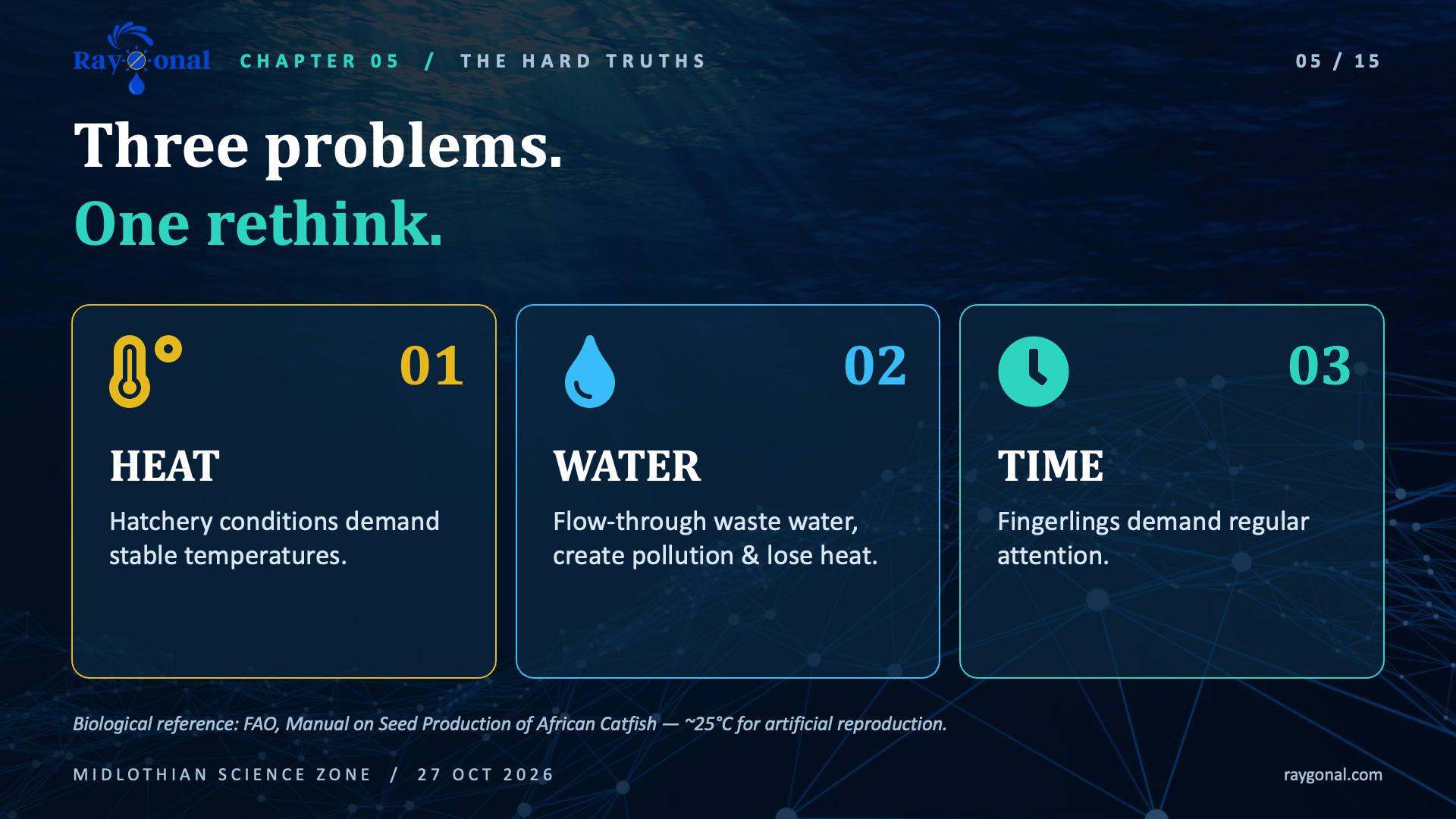
Raygonal Ltd - Presentation Slide - Problem
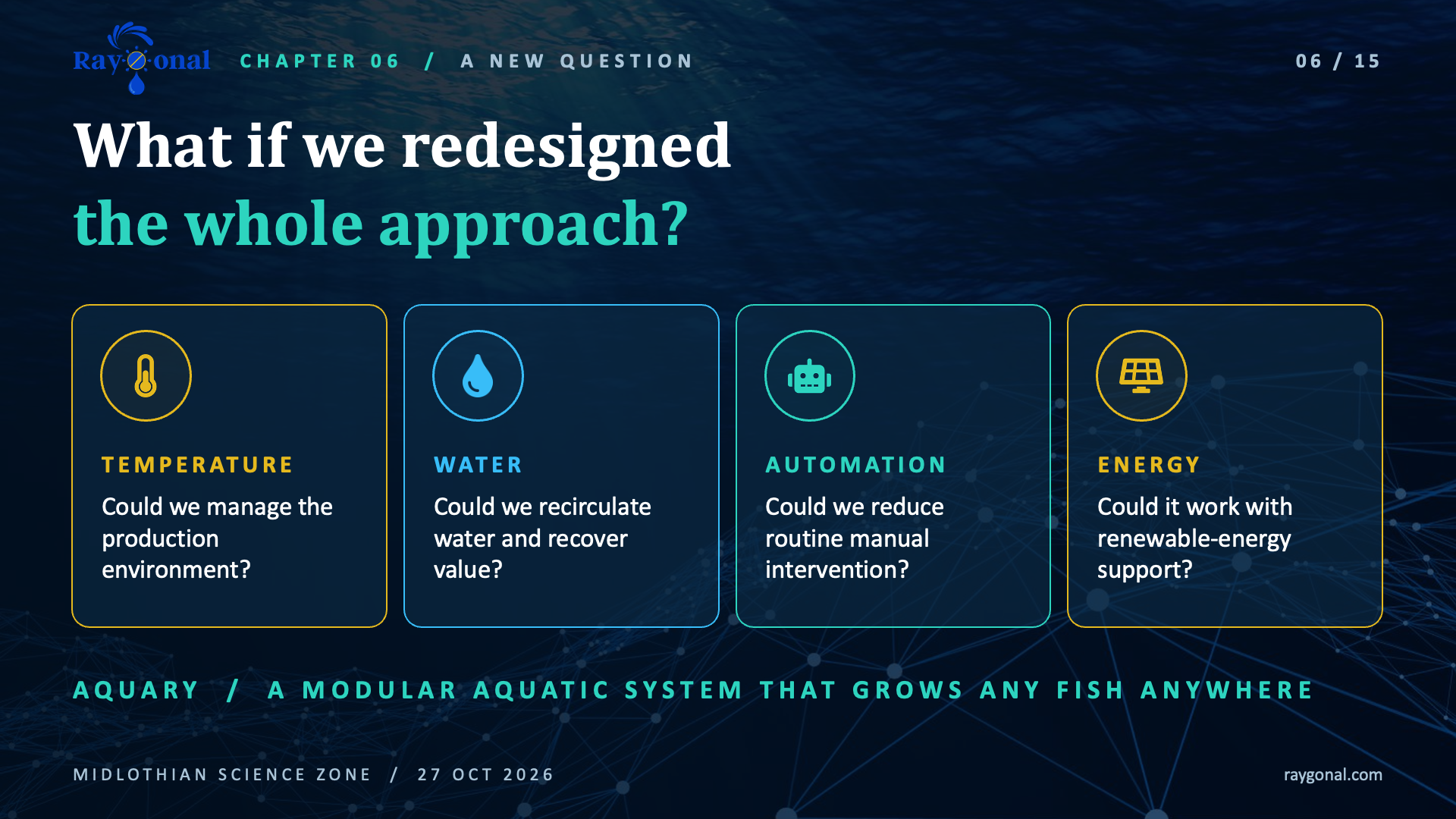
Raygonal Ltd - Presentation Slide - Solution
Building a dream
With the support of Scotland’s innovation ecosystem, Raygonal were awarded a Scottish Enterprise SMART Grant and a BBSRC Campus Innovation Award (CIA), bringing early-stage funding rounds up to £120,000 to advance the proof-of-concept testing for their tropical seafood facility.
Val Hughes-White, Director of Roslin Innovation Centre, was able to provide the ideal facility to accommodate a 20-foot square container unit on land at the Agri Field Station on Dryden Farm, taking a 3D design concept to a physical build. With the installation of a solar panel roof, Aliyu could now take this project to the next level and with the belief that if this could work effectively in the inclement weather of Scotland then it could work anywhere!
Developing a testbed
The test bed and technology system are now installed and operational, and Raygonal has commenced the process with tropical ornamental fish, such as catfish, which require less health inspectorate regulation for the brood stock.
The current container can be expanded to 40-foot square, with the modular units making it easier to scale. There is future potential to create a cluster of tanks, all reliant on renewable energy and regulated with heat pumps. These units also have the added advantage that they could located near a data centre, providing another source of direct renewable heat.
Ambition
Raygonal’s technology is flexible and transferable, and with 90% of the operation automated, this versatile and flexible model of business will attract customers such as farmers who want to diversify their food production, and producers in areas such as the Middle East. It also offers alternatives for fish farms in terms of controlling temperatures (cold, warm, tropical) depending on the species of fish being raised.
Aliyu has ambitious plans to first sell the technology and then build the ecosystem providing alternative heat sources and turn waste products into feed.
Previous funding success has fuelled Raygonal’s journey so far with Campus Innovation Award (CIA) funding, managed by Roslin Innovation Centre, through to February 2027. We wish Aliyu and Raygonal every success in securing future investment to accelerate deep tech and aquaculture automation of the Aquary system.
This presentation evoked interesting questions and discussions from around the table as well as new contacts made.
We would like to thank all contributors of our Business Forums and to those who participated. These networking events encourage collaboration, overlap and discussion which is our aim to encourage engagement across the zone.
Further information:
To find out more about Raygonal, please visit the company website and view a BBSRC Case Study following the CIA funding of the proof-of-concept project.
Our next Midlothian Science Zone Business Forum will be the final one of 2026, hosted on Tuesday 24th November at Pentlands Science Park with guest speaker Fiona Marshall, science and business leader, introducing Klarean Ltd and Supporting Women in Science (SWIS).
Please also check our website Events page or social media channels for future updates. If you would like to be notified of our bi-monthly Business Forums or to present at one of our events, please contact Emma Hood, MSZ Project Co-ordinator.