
Introduction to the new Engineering Biology Hub on the Easter Bush Campus
The Engineering Biology Hub builds on decades of world-leading research into the genetic basis of complex traits in livestock species and functional annotation of animal genomes. By integrating this expertise with cutting-edge engineering biology approaches, the Hub accelerates innovation across its core research themes: Target Discovery and Validation, Tractable In Vitro Models, Reproductive Technologies and Genome Engineering, to deliver practical advances in livestock farming.
At our Midlothian Science Zone Business Forum on Tuesday 14th April, Professor Mark Stevens, Interim Director of Roslin Institute and Interim Deputy Head of School (Research & Innovation), led a fascinating presentation on the expertise and potential of the new Engineering Biology Hub for Future Farmed Animals, to a packed Boardroom of attendees from across the zone.
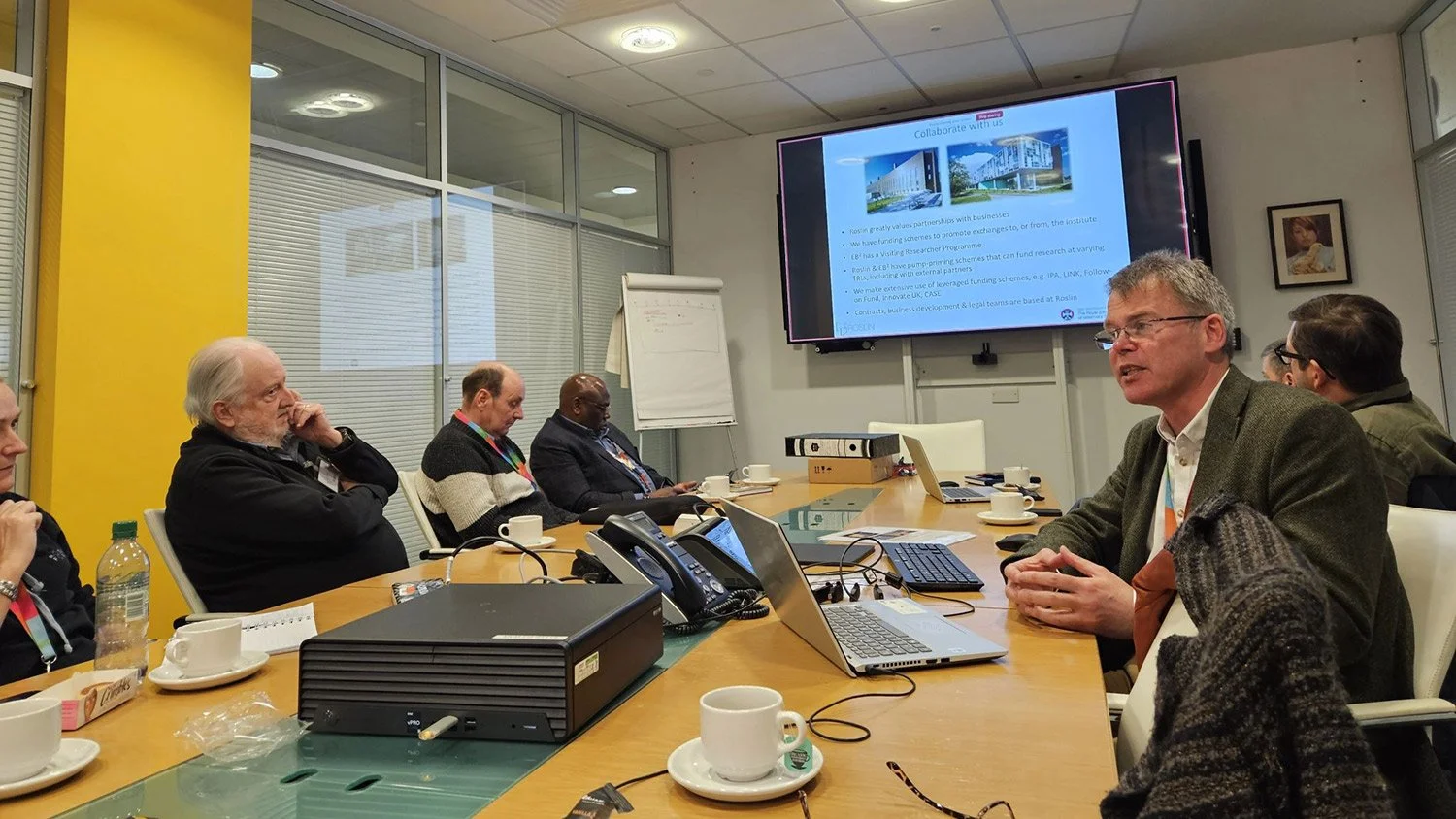
Professor Mark Stevens presenting at Midlothian Science Zone Business Forum
What is Engineering Biology?
Engineering biology is using engineering principles to design, build, test and learn from biological systems, from modifying natural organisms to creating new ones.
Professor Stevens expanded this definition to to show how engineering of genomes of farm animals can benefit the Food Systems and Biomedicine priorities of the National Engineering Biology Programme.
The University of Edinburgh is a leader in this field, with over 70 researchers in the Centre for Engineering Biology, and major investments including a £14m Mission Hub in advanced therapeutics.
Where engineering meets biology to advance the future of animal agriculture
The EB² Hub brings together technical expertise, state-of-the-art infrastructure and specialist training, to foster commercialisation opportunities, and translate research into real-world impact.
The research uses genome-wide studies and Artificial Intelligence to find and predict useful genetic changes. It has also deployed tools for editing animal genomes (like CRISPR/Cas9) and tested edits in cell and organoid models before applying them to animals.
By applying advanced reproductive techniques, animal genes can be edited quickly. The impact this can have, for example in gene edited pigs, includes resistance to porcine reproductive and respiratory syndrome virus (PRRSV) and classical swine fever virus, mitigating losses and avoiding the need for vaccines in the future.
Genome engineering and biomedicine is an essential part of the research. For example, through studying sheep with a genetic condition that mirrors Batten disease – a rare nervous system disorder that causes dementia and early death in children – gene editing has been used to create a model in which to test treatments for human infantile dementia.
The human lung and immune system are closer to pigs than mice, giving scope to test genetic associations, and novel therapies, including for severe COVID.
Professor Stevens also explained how edited and transgenic chicken lines enabled researchers to understand tissue fusion defects in human ocular coloboma, a congenital eye condition caused by a gap in the structure of the eye, which can lead to significant vision loss or total blindness in the affected eye, which can lead to blindness in the affected eye. This research could also assist in understanding other eye conditions such as cataracts.
Examples of success
CD163-edited pigs: Resistant to a major pig virus (PRRSV).
DNAJC14-edited pigs: Resistant to Classical Swine Fever Virus (CSF).
CLN1-edited sheep: Model for human infantile dementia, useful for testing therapies.
Transgenic pigs with human ACE2: Model for severe COVID-19.
Transgenic and edited chickens to study human eye defects that cause blindness.
Closing
This Business Forum highlighted ongoing research projects, research capability and partnership opportunities within the EB² Hub and evoked useful questions and discussions, citing that more resources are essential to ensure the ongoing future success of the Hub.
The EB² Hub welcomes partnerships with businesses and researchers, encourages collaborations, as well offering funding schemes and visitor research programmes.
To find out more, please look at the website https://vet.ed.ac.uk/roslin/engineering-biology which also includes Case Studies, or watch this video introduction by Professor Mark Stevens introducing the new Engineering Biology Hub at the Roslin Institute.
Video introduction by Professor Mark Stevens introducing the new Engineering Biology Hub at the Roslin Institute
Please contact us to request a copy of the presentation slides, which introduces the Roslin Institute's work in engineering biology, especially for farmed animals and related biomedical research.
We would like to thank all contributors of to our Business Forums and to those who participated. These networking events encourage collaboration, overlap and discussion which is our aim to encourage engagement across the zone.
Save the date for our next Midlothian Science Zone Business Forum on Wednesday 10th June at Vault City Brewing, a recent resident ‘in the zone’ based on BioCampus. More details and registration will be made available soon.
Please check our website Events page or social media channels for updates.
If you would like to be notified of our bi-monthly Business Forums or to present at one of our events, please contact Emma McCallum, MSZ Project Co-ordinator.